
Data Center Disaster Recovery: Planning Resilient Facilities Before Disruption Happens
Data center disaster recovery is no longer only an IT conversation. For developers, operators, architects, engineers, construction teams, and enterprise owners, it is a physical infrastructure challenge, a business continuity priority, and a project communication issue. A data center can have advanced servers, cloud architecture, and redundant software systems, but if the facility design, power strategy, cooling infrastructure, phasing plan, access routes, and emergency operations are not clearly coordinated, recovery can become slow, expensive, and difficult to manage.
Disaster recovery for data centers focuses on how a facility and its operations respond when something goes wrong. That disruption may come from a power outage, equipment failure, flood, fire, cyber incident, severe weather event, construction accident, utility disruption, overheating, or physical security issue. The goal is not only to restore systems after a failure. The goal is to plan the building, infrastructure, operations, and communication strategy so the data center can limit downtime, protect critical assets, and support a faster return to service.
For owners and development teams, this planning begins long before the facility is operational. It starts during site selection, master planning, design coordination, permitting, construction phasing, stakeholder communication, and commissioning. This is where architectural visualization, construction visualization, aerial renderings, phasing diagrams, digital twins, and clear project graphics can play a serious role.
RENDEREXPO supports data center teams by helping translate complex infrastructure into clear visual communication. Through exterior renderings, aerial views, 3D site diagrams, construction visualization, animations, and digital twin strategies, data center stakeholders can better understand risk, coordinate decisions, and communicate recovery planning with internal teams, investors, authorities, and project partners.

What Is Data Center Disaster Recovery?
Data center disaster recovery is the process of preparing for, responding to, and recovering from disruptions that affect data center operations. It includes IT systems, facility infrastructure, physical security, utilities, equipment, staffing, access, communication, and operational procedures.
A strong data center disaster recovery plan usually addresses several core questions:
What systems and operations are most critical?
What events could interrupt service?
How much downtime is acceptable?
How quickly must systems be restored?
What backup infrastructure is required?
How will staff access the site during an emergency?
How will owners, tenants, authorities, and technical teams communicate?
What parts of the facility need redundancy?
How will recovery procedures be tested and improved?
For modern data centers, disaster recovery cannot be separated from design. Power distribution, generator yards, fuel strategy, switchgear locations, cooling systems, stormwater management, access roads, secure perimeters, loading zones, equipment replacement paths, and phased expansion areas all influence recovery capability.
A recovery plan that exists only as a written document may not be enough. Decision-makers need to see how the plan works spatially. They need to understand where systems are located, how emergency access functions, how expansion phases connect, and how critical infrastructure remains protected.
Why Data Center Disaster Recovery Matters for Owners and Developers
Data centers support business operations, cloud platforms, financial systems, healthcare networks, government services, AI workloads, e-commerce, telecommunications, and critical enterprise infrastructure. Even a limited disruption can affect tenants, customers, operations, and revenue.
For owners and developers, disaster recovery planning affects more than uptime. It influences the overall value, credibility, and long-term performance of the asset.
It Supports Business Continuity
A data center is often part of a larger business continuity strategy. If a facility cannot recover quickly, the companies depending on it may face operational disruption. Owners must be able to show that the facility has a logical recovery strategy, not only strong design intent.
It Improves Stakeholder Confidence
Investors, tenants, enterprise clients, municipalities, and internal executives want to understand how a data center will perform under stress. Clear disaster recovery planning helps demonstrate that the project team has considered operational risk, redundancy, access, and long-term resilience.
It Helps Reduce Coordination Problems
Data center projects involve architects, civil engineers, structural engineers, MEP engineers, utility providers, security consultants, contractors, operators, and authorities having jurisdiction. Disaster recovery depends on all of these disciplines working together. Visual documentation helps reduce misunderstandings between teams.
It Strengthens Approvals and Presentations
Some data center projects face questions from planning boards, community stakeholders, utility partners, environmental reviewers, and executive leadership. Aerial renderings, site diagrams, phasing visuals, and infrastructure graphics can make complex recovery and resilience strategies easier to understand.
Key Components of a Data Center Disaster Recovery Strategy
A serious disaster recovery strategy should be coordinated across technology, architecture, infrastructure, and operations. The following components are especially important for data center facilities.
1. Site Risk Assessment
The recovery strategy begins with understanding site-specific risks. These may include flooding, wildfire exposure, seismic activity, severe storms, utility limitations, access constraints, nearby industrial hazards, security concerns, or limited emergency response routes.
For new data center development, site visualization can help teams evaluate:
Existing topography
Adjacent properties
Utility corridors
Access points
Flood-prone areas
Equipment yards
Stormwater systems
Security setbacks
Future expansion zones
Aerial renderings and 3D site models can make these conditions clearer for both technical and non-technical audiences.
2. Power Redundancy and Backup Systems
Power failure is one of the most important disaster recovery concerns for data centers. Backup generators, UPS systems, substations, switchgear, fuel storage, utility feeds, and electrical distribution must be planned carefully.
Disaster recovery planning should consider how power systems are accessed, maintained, replaced, protected, and phased. A generator yard that looks adequate in plan view may create circulation, acoustic, security, or maintenance challenges once modeled in context.
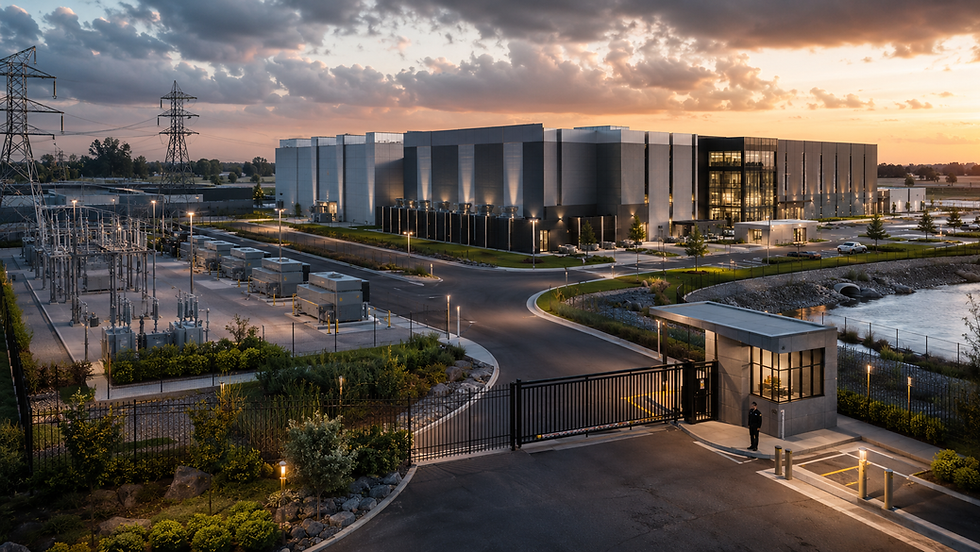
Visualization can help teams review equipment layout, screening, access routes, fencing, and the relationship between the data hall, electrical yard, utility infrastructure, and future expansion areas.
3. Cooling Resilience
Cooling failures can create serious operational risk. High-density computing, AI workloads, and advanced server environments increase the importance of mechanical coordination. Disaster recovery planning should consider redundant cooling, equipment replacement access, maintenance zones, airflow strategy, and the impact of partial system failure.
3D visualization and digital coordination can help project teams understand how mechanical yards, rooftop equipment, louvers, screening, and service areas interact with the architecture and site.
4. Network and Connectivity Redundancy
Data center disaster recovery also depends on connectivity. Diverse fiber paths, carrier access, meet-me rooms, secure pathways, and separation between critical routes can reduce vulnerability.
While network infrastructure is technical, it still has physical implications. Site diagrams and 3D coordination views can help communicate where utility routes enter the property, how they are protected, and how future phases connect to the overall campus strategy.
5. Physical Security and Emergency Access
A disaster recovery plan must account for controlled access during both normal operations and emergency conditions. Security fencing, gates, guardhouses, setbacks, vehicle circulation, loading zones, and emergency response paths need to be coordinated early.
Visualization is especially useful here because access problems are often easier to identify visually than through written descriptions. Aerial views and circulation diagrams can show how emergency vehicles, staff, service providers, and equipment deliveries move through the site.
6. Flooding, Stormwater, and Environmental Resilience
Many data center sites require detention ponds, stormwater management systems, grading strategies, and environmental coordination. These elements can directly affect disaster recovery. Poor drainage, limited access during storms, or improperly coordinated equipment elevations can create avoidable risk.
Civil and architectural visualization can help communicate how grading, water management, landscape buffers, and building placement support resilience. For planning boards and community stakeholders, these visuals can also clarify that the project has considered environmental impact and site performance.
7. Construction Phasing and Operational Continuity
Many data centers are built in phases. Disaster recovery planning should account for how future buildings, equipment yards, utilities, roads, and substations connect without interrupting existing operations.
Phasing diagrams are valuable because they show what happens over time. They can clarify:
Which infrastructure is installed first
How temporary access works
Where construction zones meet active operations
How future data halls connect to existing systems
How equipment replacement or expansion can occur without unnecessary disruption
For data center owners, phasing visuals are not just presentation graphics. They are coordination tools.
The Role of Visualization in Data Center Disaster Recovery
Data center disaster recovery plans are often documented in technical reports, diagrams, spreadsheets, specifications, and operational manuals. These documents are necessary, but they are not always easy for every stakeholder to understand.
Visualization helps bridge that gap.
Making Complex Infrastructure Understandable
A data center may include substations, generator yards, mechanical systems, security perimeters, underground utilities, stormwater infrastructure, loading zones, and multiple future phases. A well-composed aerial rendering or 3D site diagram can show how these elements work together in one view.
This improves communication between executives, consultants, operators, municipalities, and investors.
Supporting Faster Decision-Making
When project teams can see the facility in context, they can identify conflicts earlier. For example, a proposed equipment yard may interfere with future access. A fence line may need to shift. A service route may not support replacement logistics. A detention pond may affect future expansion.
Clear visuals help teams make these decisions before construction, when changes are less expensive and easier to coordinate.
Improving Approval and Entitlement Communication
Data centers often require careful explanation to local authorities and community stakeholders. Disaster recovery and resilience planning can support approval discussions when communicated clearly. Visuals can show setbacks, screening, site access, landscape buffers, stormwater management, and the relationship between the facility and surrounding roads or properties.
Supporting Investor and Tenant Presentations
Investors and tenants want confidence. They may not need every technical detail, but they do need to understand that the project has been planned with operational resilience in mind. Professional renderings, animations, and site visuals can help communicate that the facility is organized, coordinated, and prepared for long-term performance.
Digital Twins and Data Center Disaster Recovery
A digital twin is a digital representation of a physical facility, system, or asset. For data centers, digital twins can support operations, maintenance, scenario planning, and long-term facility management.
In the context of disaster recovery, digital twins can help teams visualize and understand:
Critical infrastructure locations
Equipment relationships
Maintenance zones
Access routes
Phasing and expansion plans
Operational dependencies
Potential failure scenarios
Recovery workflows
A digital twin does not replace engineering, operations, or emergency procedures. Instead, it can become a visual and data-rich environment that supports better coordination. For large data center campuses, this can be especially valuable as facilities expand and operational complexity increases.
RENDEREXPO’s digital construction and visualization capabilities can support teams that need clear, structured visual communication around data center planning, operations, and stakeholder presentations.
Disaster Recovery Planning for New Data Center Development
For new projects, disaster recovery should be considered from the earliest planning stages. Waiting until the end of design can lead to conflicts, redesign, or missed opportunities.
During Site Selection
Teams should evaluate natural hazards, utility availability, access, zoning, environmental constraints, and future expansion potential. Early visualization can compare site options and help decision-makers understand risks.
During Master Planning
The overall site plan should support redundancy, emergency circulation, phased growth, service access, and infrastructure separation. Aerial visualization and massing diagrams can help teams test these relationships.
During Design Development
Architecture, civil, structural, MEP, security, and landscape systems must be coordinated. Renderings and 3D diagrams can reveal design conflicts and improve communication.
During Construction
Construction visualization can help communicate temporary logistics, equipment installation, safety zones, access changes, and phased delivery. This is especially important when expansion work occurs near active infrastructure.
During Operations
Digital twins, facility diagrams, and updated visual documentation can support maintenance, training, emergency planning, and future upgrades.
Common Mistakes in Data Center Disaster Recovery Planning
Even strong teams can overlook important coordination issues. Common mistakes include:
Treating disaster recovery as an IT-only issue
Waiting too long to coordinate physical infrastructure
Underestimating emergency access requirements
Failing to visualize phasing and future expansion
Not communicating resilience strategies clearly to stakeholders
Overlooking site-specific risks such as flooding or utility constraints
Creating technical documentation that executives and non-technical stakeholders cannot easily understand
Separating design visuals from operational planning
These issues can be reduced when disaster recovery planning is integrated into the design, visualization, and project communication process.
How RENDEREXPO Supports Data Center Disaster Recovery Communication
RENDEREXPO helps data center teams communicate complex projects with clarity. The work is not limited to attractive images. It supports decision-making, approvals, investor confidence, construction coordination, and stakeholder alignment.
For data center disaster recovery planning, RENDEREXPO can support:
Aerial renderings of data center campuses
Exterior renderings showing equipment yards, roads, security zones, and building massing
Phasing diagrams for future expansion
Construction visualization for logistics and sequencing
3D site diagrams for access and infrastructure coordination
Animation and walkthroughs for executive or public presentations
Digital twin strategies for long-term facility communication
Visual packages for investor, tenant, permitting, and stakeholder presentations
Because data centers are technical facilities, the quality of the visual communication matters. A generic rendering may show a building. A strategic data center visualization package can show how the facility works, how it grows, how it responds to risk, and how stakeholders should understand the project.
FAQ Section
What is data center disaster recovery?
Data center disaster recovery is the planning process used to restore operations after a disruption such as power failure, equipment failure, flooding, fire, severe weather, cyber incidents, or utility interruption. It includes IT systems, building infrastructure, operations, communication, access, and recovery procedures.
Why is disaster recovery important for data centers?
Disaster recovery is important because data centers support critical business and digital operations. A disruption can affect customers, tenants, cloud services, enterprise systems, and revenue. A strong recovery plan helps reduce downtime and improves operational resilience.
What should a data center disaster recovery plan include?
A data center disaster recovery plan should include risk assessment, recovery priorities, backup power strategy, cooling redundancy, network redundancy, emergency access, communication procedures, recovery timelines, staff responsibilities, testing procedures, and facility-specific response plans.
How does facility design affect data center disaster recovery?
Facility design affects disaster recovery through power layout, cooling systems, site access, security, equipment placement, flood protection, utility routing, phasing, and maintenance access. Poor physical planning can slow recovery even when IT systems are well prepared.
Can visualization help with data center disaster recovery planning?
Yes. Visualization can help teams understand site risks, access routes, infrastructure relationships, phasing, equipment yards, security zones, and emergency planning. Renderings, diagrams, animations, and digital twins make complex recovery strategies easier to communicate.
What is the difference between business continuity and disaster recovery?
Business continuity focuses on keeping essential operations functioning during disruption. Disaster recovery focuses on restoring systems, infrastructure, and operations after an incident. For data centers, both strategies should be coordinated.
How early should disaster recovery be considered in a data center project?
Disaster recovery should be considered during site selection and master planning. Early coordination helps the project team address utility strategy, access, redundancy, expansion, environmental risks, and operational resilience before design decisions become difficult to change.

Conclusion: Data Center Disaster Recovery Starts Before the Emergency
Data center disaster recovery is not only a response plan. It is a design, infrastructure, operations, and communication strategy. The most resilient facilities are planned with a clear understanding of risk, redundancy, access, phasing, and stakeholder coordination.
For developers, owners, architects, engineers, and operators, the challenge is not only creating a technically sound plan. The challenge is making that plan understandable, coordinated, and actionable across every project phase.
RENDEREXPO helps data center teams communicate complex facilities through architectural renderings, aerial views, construction visualization, phasing diagrams, animations, and digital twin strategies. For projects that require clear communication with executives, investors, authorities, tenants, and construction teams, professional visualization can support better decisions before disruption happens.
If your team is planning, expanding, renovating, or presenting a data center project, RENDEREXPO can help develop the visual materials needed to communicate resilience, disaster recovery planning, and long-term facility strategy with clarity.


Comments