
Data Center Recycling: How Sustainable Decommissioning, Reuse, and Visualization Support Smarter Infrastructure Decisions
Data center recycling is becoming a critical part of modern infrastructure planning. As cloud computing, artificial intelligence, enterprise storage, and hyperscale development continue to expand, data centers are facing a new challenge: how to manage aging equipment, outdated infrastructure, construction waste, cooling systems, and end-of-life materials responsibly.
For owners, developers, architects, engineers, and operators, data center recycling is no longer only an environmental topic. It is part of project cost control, asset recovery, regulatory responsibility, ESG reporting, facility modernization, and long-term infrastructure strategy. A well-planned recycling and decommissioning process can reduce waste, recover value from retired assets, protect sensitive data, and support a more responsible development cycle.
At the same time, recycling decisions are often complex. A data center may contain servers, racks, cabling, backup power systems, batteries, cooling equipment, raised flooring, containment systems, security infrastructure, and building materials. Each category requires a different approach. Some assets can be reused. Some can be resold. Some must be securely destroyed. Some materials need specialized recycling partners. Others must be removed in coordination with phased construction or facility upgrades.
This is where strong project communication becomes important. Through architectural visualization, construction visualization, digital twins, aerial renderings, phasing diagrams, and stakeholder presentation visuals, RENDEREXPO helps data center teams communicate complex facility changes with clarity. Recycling may happen behind the scenes, but the planning, sequencing, approvals, and stakeholder coordination around it can benefit significantly from visual communication.

What Is Data Center Recycling?
Data center recycling is the process of responsibly managing materials, equipment, and infrastructure that are removed from a data center during renovation, expansion, relocation, modernization, or full decommissioning.
It can include:
Recycling retired servers, switches, routers, storage equipment, and cables
Recovering valuable metals and electronic components
Reusing or reselling functional IT equipment
Removing and recycling racks, raised floors, containment systems, and mechanical equipment
Managing batteries, UPS systems, generators, cooling units, and electrical infrastructure
Separating construction waste during data center renovation or demolition
Documenting asset disposition for compliance, ESG, or corporate reporting
Protecting sensitive data through secure wiping, destruction, and chain-of-custody procedures
The goal is not simply to remove old equipment. The goal is to handle every asset in a way that protects the business, reduces environmental impact, supports compliance, and improves the overall lifecycle value of the facility.
Why Data Center Recycling Matters
Data centers are asset-heavy environments. They contain large volumes of technology, metal, wiring, cooling infrastructure, electrical systems, backup power equipment, and specialized construction components. As data processing demands increase, many facilities must upgrade hardware, improve cooling capacity, increase power density, or replace outdated equipment.
Without a clear recycling strategy, these upgrades can create unnecessary waste and operational risk.
Data center recycling matters because it supports five major business priorities: sustainability, data security, cost recovery, compliance, and project efficiency.
Sustainability and Waste Reduction
Data centers are often evaluated by energy use, water use, carbon footprint, and operational efficiency. However, sustainability also includes embodied carbon, material reuse, electronic waste reduction, and the lifecycle of physical equipment.
When equipment is reused, refurbished, resold, or recycled correctly, it can reduce the demand for new material extraction and manufacturing. This is especially important for electronic components that contain metals, circuit boards, plastics, batteries, and specialized materials.
For developers and operators with ESG goals, data center recycling can become part of a broader sustainability story. It shows that the facility is not only focused on performance during operation, but also on responsible material management throughout its lifecycle.
Data Security and Asset Control
Recycling data center equipment is not the same as recycling ordinary office electronics. Servers, storage devices, networking equipment, and backup systems may contain sensitive corporate, financial, client, or operational data.
Before any equipment leaves the facility, owners need a controlled process for inventory, data wiping, physical destruction when required, chain of custody, and documentation. A strong recycling plan helps prevent data exposure while allowing functional assets to be reused or recovered responsibly.
For enterprise clients, financial institutions, healthcare organizations, government-related users, and cloud infrastructure operators, secure asset disposition is a major part of risk management.
Cost Recovery and Asset Value
Many retired data center assets still have residual value. Servers, racks, switches, memory, processors, storage systems, power equipment, and certain mechanical components may be resold, refurbished, redeployed, or harvested for parts.
A smart data center recycling strategy can help owners recover value from equipment that might otherwise be treated as waste. This does not mean every item should be resold. Some equipment is obsolete or unsuitable for reuse. But with proper inventory and evaluation, asset recovery can offset part of the cost of decommissioning, relocation, or modernization.
Compliance and Documentation
Data center recycling may involve environmental regulations, corporate procurement rules, ESG reporting, data protection requirements, and vendor compliance policies. Documentation matters.
Owners may need records that show what was removed, how assets were handled, which vendors were used, whether materials were recycled or destroyed, and how sensitive data was managed.
For large facilities, this documentation can become part of broader project records, sustainability reporting, investor communication, or internal governance.
Better Project Planning
Data center recycling often occurs during complex projects. A facility may need to remain partially operational while certain rooms, racks, cooling zones, or electrical systems are removed or upgraded. In other cases, a full decommissioning must be coordinated with real estate disposition, tenant turnover, construction work, or new data center development.
Visual planning tools can help teams understand sequencing, access routes, staging zones, temporary conditions, equipment removal paths, and phasing. This reduces confusion and supports better communication among owners, architects, engineers, contractors, IT teams, security teams, and recycling vendors.

Data Center Recycling During Decommissioning
Data center decommissioning is one of the most common situations where recycling becomes a major priority. A decommissioning project may involve shutting down a legacy facility, consolidating operations into another site, moving workloads to the cloud, or preparing a property for redevelopment.
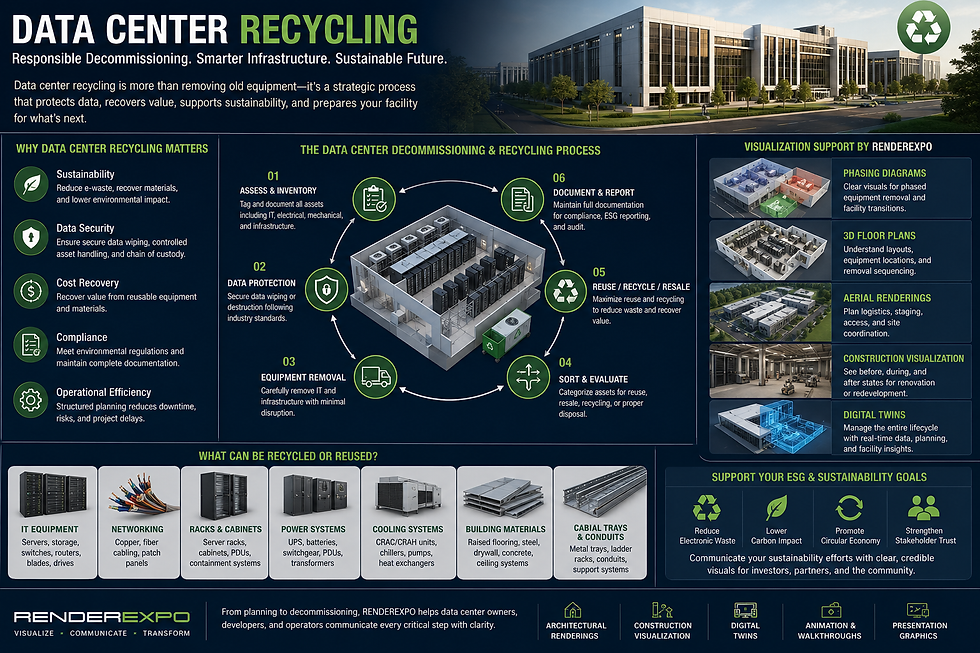
A typical decommissioning process may include:
Asset inventory and tagging
Data migration or workload transfer
Secure data wiping or destruction
Equipment removal and sorting
Reuse, resale, recycling, or disposal decisions
Removal of racks, cabling, cooling systems, and electrical components
Building restoration or demolition coordination
Final documentation and reporting
The most successful decommissioning projects are planned early. When recycling is treated as an afterthought, teams may lose asset value, create unnecessary waste, or face delays during removal. When recycling is built into the project plan, the process becomes more controlled and predictable.
What Materials Can Be Recycled in a Data Center?
A data center contains several categories of recyclable or recoverable materials. Each category requires careful handling.
IT Hardware
This includes servers, storage arrays, switches, routers, firewalls, memory, processors, drives, and related hardware. Some equipment can be reused internally. Some can be refurbished or resold. Some must be dismantled for parts or recycled through certified electronics recycling channels.
Cabling and Network Infrastructure
Data centers contain large quantities of copper and fiber cabling. Cable removal can be labor-intensive, especially in facilities with overhead trays, raised floors, dense rack layouts, or legacy cable pathways. Proper sorting can improve recycling value and reduce waste.
Racks, Cabinets, and Containment Systems
Server racks, cabinets, containment panels, doors, and structural support elements may be reused, resold, or recycled as metal. During renovation, these components often need to be coordinated with floor plans, equipment layouts, airflow strategies, and future rack density.
Power and Electrical Equipment
Power distribution units, switchgear, transformers, UPS systems, busways, panels, and backup power components require specialized evaluation. Some equipment may have reuse value, while other components require careful recycling or disposal.
Batteries and Backup Systems
Battery systems must be handled with strict care. They may contain materials that require specialized recycling partners and safety procedures. Battery removal should be coordinated with facility operations, fire safety, and electrical shutdown planning.
Mechanical and Cooling Equipment
Cooling infrastructure may include CRAH units, CRAC units, chillers, pumps, piping, containment systems, heat exchangers, and related mechanical equipment. Some systems may be reused or refurbished, while others may be recycled as metal or processed through specialty vendors.
Construction and Building Materials
During renovation or demolition, data centers may generate construction waste such as concrete, steel, drywall, ceiling systems, flooring, insulation, doors, and architectural finishes. Sustainable construction waste management can reduce landfill impact and support project sustainability goals.
The Role of Visualization in Data Center Recycling
Data center recycling is technical, but it is also visual. Owners and project teams need to understand what is being removed, what remains operational, where equipment is staged, how the work is phased, and how the facility will look after modernization or redevelopment.
RENDEREXPO supports data center teams by creating visual tools that make complex recycling, decommissioning, and renovation strategies easier to understand.
Phasing Visuals for Equipment Removal
Phasing diagrams can show which rooms, racks, power zones, or cooling areas will be removed first. This is especially useful when a facility remains partially operational during recycling or modernization.
Clear phasing visuals help stakeholders understand sequencing, temporary conditions, and operational boundaries. They also support coordination between IT, construction, facilities, security, and vendor teams.
3D Floor Plans and Facility Layouts
3D floor plans can communicate the relationship between server rooms, equipment yards, loading areas, staging zones, electrical rooms, cooling infrastructure, and circulation routes. For complex facilities, this is often more useful than a traditional 2D plan alone.
These visuals can help teams identify removal paths, access constraints, and areas where temporary protection may be needed.
Aerial Renderings for Site-Level Planning
Aerial renderings are useful when recycling or decommissioning affects the entire data center campus. They can show loading areas, truck access, temporary staging zones, security fencing, utility yards, substation areas, expansion zones, and future redevelopment plans.
For owners, investors, municipalities, and development partners, aerial visuals help connect technical recycling decisions to the larger site strategy.
Construction Visualization for Renovation and Reuse
When recycling is part of a renovation or adaptive reuse strategy, construction visualization can show existing conditions, demolition scope, retained infrastructure, new equipment, upgraded spaces, and final outcomes.
This is particularly valuable for data centers being repositioned, expanded, or partially converted for new uses.
Digital Twins for Lifecycle Management
Digital twins can help data center owners document assets, systems, spaces, and facility conditions over time. When integrated into a lifecycle strategy, a digital twin can support planning for maintenance, replacement, upgrades, and eventual recycling or decommissioning.
For large or multi-phase data center campuses, digital twins can improve long-term visibility into how infrastructure changes over time.
Data Center Recycling and ESG Communication
Many companies are under pressure to communicate sustainability performance more clearly. Data center recycling can support ESG narratives, but only when the process is documented and explained in a credible way.
Renderings, diagrams, and visual presentations can help owners communicate:
How materials are being reused or recycled
How old infrastructure is being removed
How new systems improve efficiency
How site planning supports sustainability
How phased upgrades reduce disruption
How a facility modernization aligns with long-term environmental goals
The key is to avoid vague sustainability claims. A strong presentation should be specific, visual, and grounded in actual project decisions.
Data Center Recycling for Renovation, Expansion, and Redevelopment
Not every recycling project involves shutting down a full facility. In many cases, recycling happens as part of a broader capital improvement plan.
A data center may be:
Upgrading from older equipment to higher-density infrastructure
Expanding capacity for AI or cloud workloads
Replacing air-based cooling with more advanced cooling systems
Removing outdated cabling and rack layouts
Reconfiguring electrical rooms and backup power systems
Preparing part of a site for a new building phase
Converting an older facility for a new tenant or operator
In these situations, recycling must be coordinated with design, engineering, operations, and construction. Visualization can help show what is changing and why it matters.
Best Practices for Data Center Recycling
A responsible data center recycling strategy should be planned before equipment removal begins.
Start With a Detailed Asset Inventory
Teams should identify what exists, where it is located, what condition it is in, and whether it contains sensitive data. This inventory becomes the foundation for reuse, resale, recycling, or disposal decisions.
Separate Reuse From Recycling
Not every retired asset should be immediately recycled. Some equipment may have value for internal redeployment, secondary markets, spare parts, or donation programs. Recycling should be part of a hierarchy that considers reuse first when practical.
Protect Data Before Equipment Leaves the Site
Data-bearing assets should be wiped, destroyed, or handled according to the owner’s security requirements before leaving the facility. Documentation should be maintained throughout the process.
Work With Qualified Recycling and ITAD Partners
Data center owners should work with specialized vendors who understand electronics recycling, secure asset disposition, environmental handling, and proper documentation.
Coordinate Recycling With Construction Phasing
When recycling is part of a renovation or expansion, removal should be coordinated with construction schedules, facility operations, access control, safety planning, and future infrastructure installation.
Use Visual Communication for Stakeholder Alignment
Technical teams may understand the details, but executives, investors, municipalities, and non-technical stakeholders often need clear visuals. Renderings, diagrams, 3D plans, and digital models can help communicate the strategy efficiently.
How RENDEREXPO Supports Data Center Recycling Projects
RENDEREXPO helps data center owners, developers, architects, engineers, and construction teams communicate complex project conditions through high-quality architectural visualization and digital construction support.
For data center recycling, decommissioning, renovation, and modernization projects, RENDEREXPO can support:
Existing-condition visualization
Phasing and sequencing diagrams
3D floor plans for equipment removal and redevelopment
Aerial renderings for site logistics and stakeholder presentations
Construction visualization for renovation and infrastructure upgrades
Digital twin strategies for facility lifecycle planning
Investor and executive presentation visuals
Entitlement, approval, and community communication graphics
Marketing visuals for repositioned or upgraded data center assets
The value is not only in producing attractive images. The value is in making technical infrastructure decisions easier to understand, review, approve, and execute.
FAQ Section
What is data center recycling?
Data center recycling is the responsible handling of retired equipment, materials, and infrastructure from a data center. It can include recycling servers, cables, racks, batteries, cooling systems, electrical equipment, and construction materials while protecting data security and recovering asset value.
Why is data center recycling important?
Data center recycling reduces electronic waste, supports sustainability goals, protects sensitive data, helps recover value from retired equipment, and improves documentation during decommissioning, renovation, or facility modernization.
What equipment can be recycled from a data center?
Common recyclable data center assets include servers, storage systems, switches, routers, cables, racks, cabinets, power equipment, batteries, cooling equipment, raised flooring, and construction materials. Some assets may also be reused, refurbished, or resold.
How does data center recycling relate to decommissioning?
During data center decommissioning, equipment and infrastructure must be removed, secured, documented, reused, recycled, or disposed of. Recycling is a major part of the decommissioning process because it helps manage materials responsibly and reduce waste.
Can data center equipment be reused instead of recycled?
Yes. Many data center assets may be reused, redeployed, refurbished, or resold if they are still functional and meet performance or security requirements. Recycling is usually best for equipment that is obsolete, damaged, or no longer suitable for reuse.
How can visualization help with data center recycling?
Visualization can show removal phasing, equipment layouts, staging zones, site access, construction sequencing, and final redevelopment plans. This helps owners, contractors, IT teams, investors, and stakeholders understand the recycling and decommissioning strategy more clearly.
Does RENDEREXPO provide data center recycling services directly?
RENDEREXPO does not position itself as an electronics recycler or IT asset disposition vendor. RENDEREXPO supports data center recycling-related projects through architectural visualization, construction visualization, digital twins, phasing diagrams, aerial renderings, and stakeholder presentation visuals.
Conclusion: Data Center Recycling Requires Clear Planning and Strong Communication
Data center recycling is now part of responsible infrastructure development. It affects sustainability, cost recovery, data security, compliance, construction planning, and long-term facility value. Whether a project involves full decommissioning, phased renovation, equipment replacement, or campus redevelopment, recycling decisions should be planned with the same level of care as design, engineering, and construction.
For owners and project teams, the challenge is not only deciding what to recycle. The challenge is communicating the full strategy clearly: what is being removed, what is being reused, how the work is phased, where materials are handled, and how the facility will function after the upgrade or transition.
RENDEREXPO helps data center teams communicate these decisions through professional architectural renderings, aerial visualization, 3D floor plans, construction visualization, digital twins, and presentation graphics. For data center developers, owners, architects, engineers, and construction teams, strong visuals can make complex recycling and decommissioning strategies easier to understand, approve, and execute.
To support your next data center renovation, decommissioning, modernization, or infrastructure presentation, contact RENDEREXPO for high-quality visualization and digital construction communication support.


Comments