
Blanking Panels for Data Centers: Why Small Rack Gaps Create Big Cooling Problems
In a data center, airflow is not a minor operational detail. It affects cooling performance, equipment reliability, energy use, rack density, and long-term facility efficiency. One of the simplest components in that airflow strategy is also one of the most commonly overlooked: blanking panels for data centers.
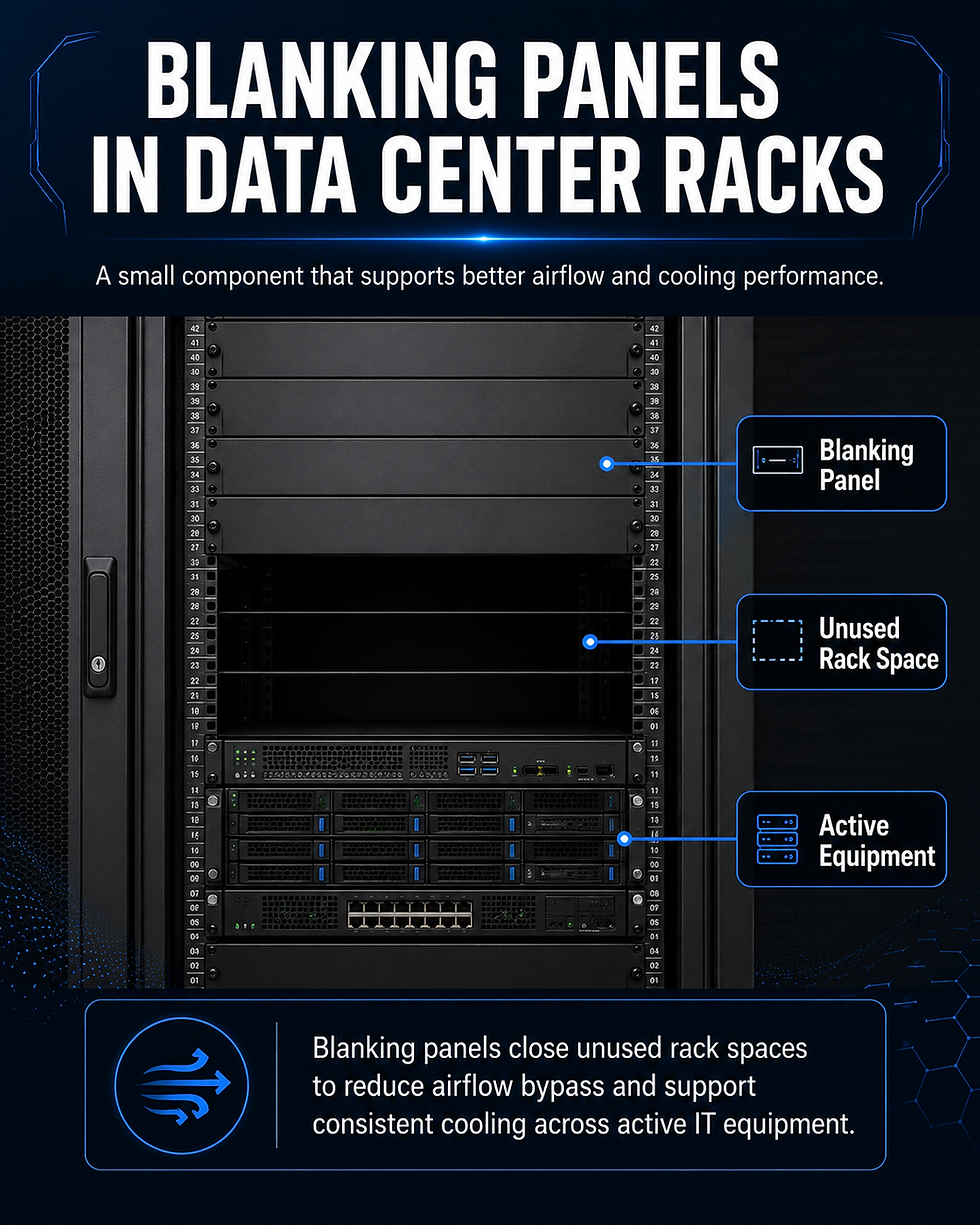
Blanking panels, also called filler panels or rack blanking plates, are installed in unused rack spaces to block open U positions. Their purpose is straightforward: prevent hot exhaust air from recirculating into the cold aisle and stop conditioned air from bypassing active IT equipment. In practice, this small detail can influence the thermal performance of an entire rack row.
For developers, data center operators, architects, engineers, and construction teams, blanking panels are not only a facilities-management accessory. They are part of a larger design and operational strategy that includes hot aisle/cold aisle planning, containment, rack layout, equipment density, cable management, raised floor coordination, mechanical distribution, and thermal modeling.
For companies planning, designing, marketing, or presenting data center projects, these technical elements also need to be communicated clearly. That is where high-quality data center visualization becomes valuable. RENDEREXPO helps data center developers, architects, engineers, and project owners explain complex infrastructure decisions through architectural renderings, technical visualization, construction visualization, animations, digital twins, and stakeholder presentation visuals.

What Are Blanking Panels in a Data Center?
Blanking panels are flat panels installed in empty rack units inside server cabinets. They are typically available in 1U, 2U, or larger modular sizes and may be made from plastic, metal, or other durable materials depending on the data center’s standards.
Their function is to close unused openings in server racks. Without blanking panels, empty rack spaces create paths for air to move in the wrong direction. Cold air that should pass through active servers may escape through open rack gaps. Hot exhaust air from the rear of the rack may circulate back to the front intake side. This reduces cooling efficiency and can create uneven temperatures across the rack face.
A properly managed rack should guide cold air into IT equipment and direct hot exhaust away from the intake zone. Blanking panels support that separation by closing the openings that interrupt the airflow path.
Why Blanking Panels Matter for Data Center Airflow
Data centers depend on controlled airflow. The basic principle is simple: cold air should reach the front intake side of servers, and hot air should be removed from the exhaust side without mixing back into the cold aisle.
When rack spaces are left open, air follows the path of least resistance. Instead of moving through active equipment, conditioned air may pass through empty slots. At the same time, hot air from the rear of the rack can migrate toward the front of the cabinet. This creates recirculation, hot spots, and inefficient cooling.
Blanking panels help solve this issue by maintaining separation between the cold aisle and hot aisle at the rack level. They are especially important in high-density environments, colocation facilities, enterprise data centers, hyperscale support spaces, edge data centers, and mission-critical rooms where airflow stability matters.
Blanking Panels Data Center Benefits
1. Reduced Hot Air Recirculation
The most important benefit of blanking panels is reducing hot air recirculation. When unused rack openings are exposed, hot exhaust air can loop back to the server intake side. This can increase inlet temperatures and create unnecessary stress on IT equipment.
Blanking panels close those gaps and help maintain the intended airflow pattern. This supports more consistent intake temperatures across the rack.
2. Improved Cooling Efficiency
Cooling systems work harder when airflow is poorly managed. If cold air bypasses equipment or hot air mixes into the cold aisle, CRAC units, CRAH units, in-row cooling systems, or other mechanical systems may need to compensate.
Blanking panels help cooling systems perform more efficiently because conditioned air is directed where it is needed. This can support more stable thermal conditions and reduce unnecessary cooling demand.
3. Better Rack-Level Temperature Control
Even in a well-designed data hall, poor rack management can create local thermal problems. Open spaces in server racks can cause temperature variation from the bottom to the top of the cabinet or from one rack to the next.
Blanking panels help create a cleaner airflow path across the entire rack face. This is important for maintaining predictable performance in dense deployments.
4. Support for Hot Aisle and Cold Aisle Design
Hot aisle/cold aisle organization is one of the most common airflow strategies in data centers. However, the strategy depends on controlling where air moves. If racks have open gaps, the aisle arrangement becomes less effective.
Blanking panels support hot aisle/cold aisle separation by closing pathways that allow air to mix through the rack. They are a rack-level detail that reinforces the room-level airflow plan.
5. Stronger Containment Performance
Cold aisle containment and hot aisle containment systems are designed to separate supply air from return air. But containment does not solve every airflow problem by itself. If unused rack spaces remain open, air can still move through the cabinets in ways that weaken the containment strategy.
Blanking panels help containment systems perform as intended. They close rack-level openings and reduce leakage points inside the contained environment.
Blanking Panels and Data Center Design Coordination
Blanking panels may seem like an operations detail, but they are connected to larger design and construction decisions. In a data center project, airflow management involves multiple disciplines:
Architectural planning
Mechanical engineering
Electrical coordination
Rack layout and IT planning
Cable tray routing
Raised floor or slab-on-grade strategy
Containment planning
Fire protection coordination
Phasing and expansion planning
Commissioning and operational standards
For example, a data hall may be designed with proper aisle spacing and mechanical capacity, but poor rack sealing can reduce the effectiveness of that design. Similarly, future expansion zones may require a clear strategy for partial rack loading, phased equipment installation, and temporary blanking during growth periods.
This is why blanking panels should be considered early in the planning and operational standards for a data center, not only after thermal issues appear.
Common Mistakes with Data Center Blanking Panels
Leaving Empty Rack Spaces Open
The most obvious mistake is leaving unused rack units uncovered. Even small gaps can affect airflow patterns, especially in dense racks or contained aisles.
Using Panels Inconsistently
Blanking panels should be installed consistently across racks. Partial installation may solve some problems but leave other airflow paths open.
Ignoring Side Gaps and Cable Openings
Blanking panels address open rack units, but they do not solve every leakage point. Gaps between racks, cable penetrations, floor openings, side gaps, and missing brush grommets can also disrupt airflow.
Treating Blanking Panels as a Substitute for Good Design
Blanking panels are important, but they are not a replacement for proper mechanical design, rack planning, containment strategy, or commissioning. They work best as part of a complete airflow management approach.
Forgetting About Phasing
Many data centers are built in phases. A rack may be partially populated for months before reaching full equipment density. During that time, blanking panels are essential for maintaining airflow performance.

How Visualization Helps Explain Data Center Airflow Strategy
Data centers are technically complex. Many stakeholders involved in approvals, investment, leasing, design, construction, and operations do not read mechanical drawings or rack elevations every day. They need clear visual communication.
RENDEREXPO supports data center teams by creating visual materials that explain the project at multiple levels, including exterior architecture, site planning, data hall organization, equipment zones, phasing, access, service yards, substations, mechanical yards, containment concepts, and interior technical environments.
For blanking panels and airflow-related design, visualization can support:
Data Hall Renderings
Interior data hall renderings can show rack rows, aisle organization, containment, ceiling systems, lighting, and equipment layout. These images help owners, investors, and non-technical stakeholders understand the operational logic of the space.
Construction Visualization
Construction visualization can explain phasing, equipment installation, rack deployment, containment sequencing, and coordination between trades. For data centers, this is valuable because construction and commissioning often depend on precise sequencing.
Technical Diagrams and Exploded Views
A technical visual can show how blanking panels fit into the broader airflow strategy. This may include cold aisle intake, hot aisle exhaust, rack gaps, return air paths, and containment boundaries.
Investor and Approval Presentations
Data center projects often require clear communication with municipalities, utility providers, investors, development partners, and community stakeholders. High-quality visuals help explain that the facility is not only a large industrial building, but a carefully planned infrastructure asset.
Digital Twins and Operational Communication
Digital twins can help project teams organize data, visualize facility systems, and communicate operational conditions. For data centers, this may include rack planning, thermal zones, equipment locations, phased deployment, and infrastructure coordination.
Blanking Panels in High-Density Data Centers
As rack density increases, airflow control becomes more important. Higher-density environments place more pressure on cooling systems and require more disciplined rack management. In these conditions, even small gaps can affect thermal performance.
Blanking panels are particularly important when:
Racks are partially populated
Equipment density varies from rack to rack
Cabinets include mixed equipment types
Top-of-rack switches have different airflow directions
Containment systems are installed
Cooling capacity is closely matched to IT load
Future expansion is planned in phases
The facility is preparing for higher-density deployments
A strong airflow strategy should not assume that all racks will be fully populated from day one. Real-world data centers change over time. Equipment is added, removed, replaced, and reconfigured. Blanking panels help maintain airflow discipline during those changes.
What Data Center Owners Should Consider
When evaluating blanking panels for a data center, owners and operators should consider several practical questions:
Are all unused rack spaces covered?
Are panels easy to install and remove during equipment changes?
Are the panels compatible with the rack system?
Are there standards for temporary and permanent rack blanking?
Are operations teams trained to replace panels after equipment changes?
Are side gaps, cable penetrations, and floor openings also sealed?
Is rack airflow being reviewed during commissioning or operational audits?
Are blanking panels included in the data center’s visual and technical documentation?
These questions matter because airflow management is not only a design issue. It is also an operational discipline.
Why RENDEREXPO Connects Technical Detail with Project Communication
A data center project must communicate with many audiences. Engineers need accuracy. Developers need clarity. Investors need confidence. Municipal reviewers need context. Construction teams need coordination. Operators need usable information.
RENDEREXPO’s value is in translating complex architectural, technical, and operational ideas into clear visual communication. For data centers, this may include exterior renderings, aerial renderings, data hall interiors, construction phasing visuals, animation, VR presentations, digital twin strategies, and technical diagrams.
Blanking panels are a small example of a larger truth: data center performance depends on details. The way those details are planned, coordinated, and communicated can affect how well the project is understood before it is built.
FAQ Section
What are blanking panels in a data center?
Blanking panels are panels installed in unused rack spaces to block open areas in server cabinets. They help prevent hot air recirculation and improve airflow control inside the rack.
Why are blanking panels important for data center cooling?
Blanking panels help separate cold intake air from hot exhaust air. By closing empty rack spaces, they reduce air mixing, support stable server inlet temperatures, and improve cooling efficiency.
Do blanking panels save energy in data centers?
Blanking panels can support energy savings by reducing bypass airflow and helping cooling systems operate more efficiently. The actual savings depend on the facility layout, rack density, cooling system, and overall airflow management strategy.
Are blanking panels required in every server rack?
Any rack with unused spaces should generally use blanking panels as part of good airflow management practice. Fully populated racks may need fewer panels, but partially populated racks should not leave open U spaces exposed.
What size blanking panels are used in data centers?
Common blanking panel sizes include 1U and 2U, though larger panels are also available. The right size depends on the number of unused rack units that need to be covered.
Are blanking panels enough to fix data center hot spots?
Blanking panels can help reduce hot spots, but they are not always the full solution. Hot spots may also be caused by poor containment, cable openings, incorrect airflow direction, overloaded racks, poor tile placement, or mechanical system issues.
How can data center visualization help explain airflow management?
Data center visualization can show rack layouts, hot aisle/cold aisle organization, containment systems, mechanical zones, and technical airflow concepts in a clear visual format. This helps owners, investors, designers, and construction teams understand the project more effectively.
Conclusion
Blanking panels for data centers may be simple components, but they play an important role in airflow management, cooling efficiency, and rack-level thermal control. They help reduce hot air recirculation, support hot aisle/cold aisle performance, strengthen containment strategies, and improve the reliability of the overall cooling approach.
For data center developers, architects, engineers, and project owners, the lesson is clear: technical details matter. A successful data center is not defined only by its exterior architecture, power capacity, or equipment count. It is defined by how well its systems are planned, coordinated, communicated, and operated.
RENDEREXPO helps data center teams communicate these complex ideas through professional architectural visualization, data center renderings, aerial views, animations, construction visualization, digital twins, and investor presentation visuals. If your project requires clear visual communication for design, approvals, marketing, construction coordination, or stakeholder alignment, RENDEREXPO can support the process with technically informed visualization built for serious project teams.


Comments