
AI in Multifamily Property Management: What Owners, Developers, and Operators Need to Understand
Artificial intelligence is no longer a future concept in multifamily real estate. It is already reshaping how apartments are leased, how maintenance requests are handled, how residents communicate with property teams, and how owners evaluate operating costs. For developers, landlords, property managers, investors, architects, and construction teams, AI in multifamily property management is becoming a serious operational issue rather than a technology experiment.
The conversation, however, is not only about efficiency. It is also about people, communication, resident trust, workforce transition, and the way real estate companies explain change to internal teams and external stakeholders.
Recent industry discussions around AI-powered leasing, maintenance triage, and centralized property operations have made one point clear: multifamily operators are under pressure to control costs while maintaining service quality. At the same time, employees are increasingly aware that automation may change how their roles are structured. The National Apartment Association has noted that automation and AI are becoming more common in rental housing operations, including leasing workflows and renter communication.
For RENDEREXPO, this shift is important because AI adoption in real estate is not only a software decision. It is also a communication challenge. Owners and developers need clear visuals, operational diagrams, resident-facing explanations, leasing presentations, digital twins, and construction visualization tools that help teams understand how buildings, systems, workflows, and people interact.
AI may automate parts of property management, but successful implementation still depends on clarity.
Why Multifamily Operators Are Turning to AI
Multifamily owners are operating in a more complex financial environment. Rent growth has moderated in many markets, while insurance, maintenance, labor, financing, utilities, and construction-related costs continue to pressure operating margins. RealPage reported that average annualized multifamily expense costs per unit rose significantly between the first quarter of 2021 and the first quarter of 2024, while other industry sources continue to track elevated operating cost pressure across the sector.
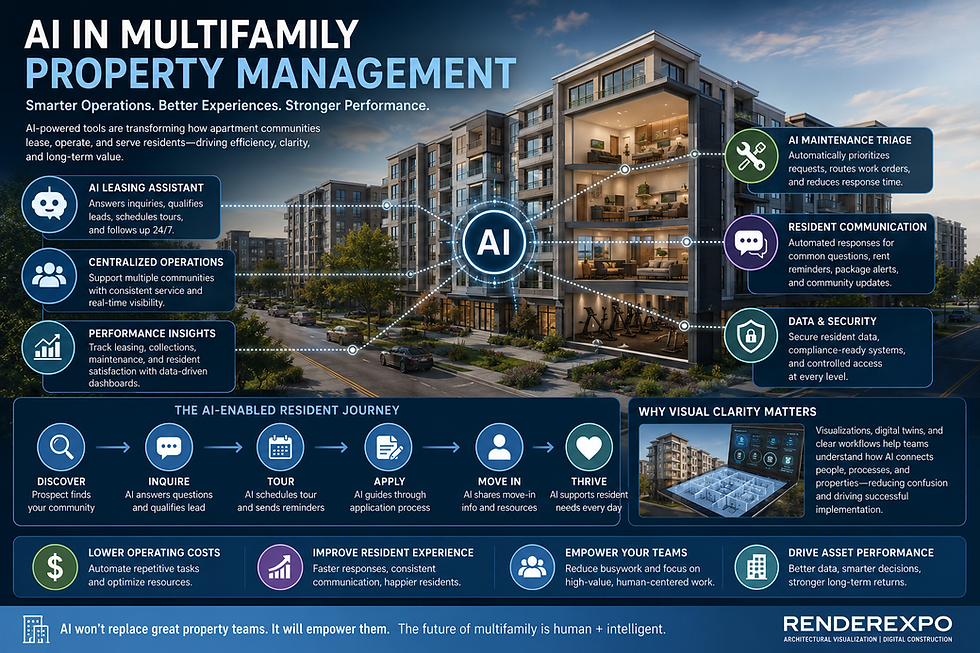
That financial pressure explains why AI has become attractive to property owners and asset managers. In many multifamily portfolios, the most common AI use cases include:
Responding to leasing inquiries
Scheduling tours
Answering basic resident questions
Routing maintenance requests
Prioritizing urgent work orders
Supporting renewal communication
Organizing resident service data
Assisting centralized management teams
Tracking leasing performance and response times
These applications are not abstract. They directly affect daily property operations. A leasing inquiry that once required a person to answer a phone call or email may now be handled by an AI assistant. A maintenance request that once went directly to an on-site team may now be filtered by urgency, category, and available staff. A resident question about rent payment, parking, access, or amenities may be answered automatically before a human team member becomes involved.
For owners, the appeal is clear: faster response times, fewer repetitive tasks, better data collection, and potentially lower operating costs. For employees, the concern is equally clear: if AI can perform a growing share of administrative and leasing work, what happens to existing roles?
AI in Multifamily Property Management Is Also a Workforce Issue
The real estate industry often discusses AI through the language of efficiency. That is understandable, but incomplete. AI in property management changes how work is distributed, how teams are measured, and how residents experience service.
A poorly managed AI rollout can create confusion. On-site teams may feel that new technology is being introduced without context. Leasing professionals may worry that automation is being used to reduce headcount. Maintenance teams may question whether AI triage will improve workflow or create additional administrative friction. Residents may become frustrated if automated systems feel impersonal or fail to escalate issues correctly.
This is where communication becomes critical.
Real estate companies need to explain AI implementation in a way that is honest, specific, and operationally clear. Generic internal messaging about “innovation” is not enough. Employees need to understand which tasks are changing, which responsibilities remain human-led, how performance expectations will shift, and how resident service standards will be protected.
A responsible AI rollout should answer practical questions:
What tasks will AI handle?
What tasks will remain with on-site teams?
Who reviews escalated issues?
How will leasing quality be measured?
How will resident satisfaction be protected?
How will staff roles evolve?
What training will be provided?
How will the company prevent service gaps?
When companies avoid these questions, AI adoption can quickly become a morale problem. When they address them clearly, technology can become a tool for operational alignment instead of internal distrust.
The Rise of Centralized Property Operations
One of the biggest shifts connected to AI is centralization. In multifamily operations, centralization usually means moving certain tasks away from individual on-site property teams and into regional, portfolio-level, or remote support structures.
AI makes this model easier because software can manage high-volume communication across multiple properties. Instead of every community handling every inquiry independently, centralized systems can support leasing, renewals, resident communication, reporting, and maintenance intake across a portfolio.
This structure may help owners create more consistent service standards, especially across large portfolios. It can also help operators collect better data about response times, conversion rates, resident issues, and recurring maintenance patterns.
But centralization also changes the human experience of property management.
For residents, the question becomes whether service feels faster or more distant. For employees, the question becomes whether centralized workflows create better focus or reduce local control. For ownership, the question becomes whether the efficiency gains are worth the operational change management required.
This is why multifamily owners should not think of AI as a simple plug-in. It is a business model adjustment.
Why Visual Communication Matters in AI Implementation
AI property management tools often promise efficiency through dashboards, workflows, and automation. But many real estate teams still struggle to visualize how those systems interact with the physical building, leasing journey, resident experience, and maintenance process.
That is where architectural visualization and digital construction support become valuable.
For a multifamily owner or developer, visual communication can help explain AI-enabled operations before confusion becomes resistance. RENDEREXPO’s work in architectural visualization, digital twins, 3D floor plans, aerial renderings, animation, and construction visualization can support this type of communication by making complex systems easier to understand.
For example, an operator introducing AI-supported maintenance triage could use a visual workflow diagram tied to the building plan. A developer preparing an investor presentation could show how centralized leasing supports multiple buildings across a master-planned community. A property owner could use animated resident journey visuals to explain how prospects move from inquiry to tour to application.
A construction or operations team could use a digital twin to connect building systems, resident service areas, access points, amenity zones, and maintenance workflows.
These tools are not decorative. They support operational clarity.
In multifamily real estate, many decisions involve people who do not read technical documents the same way. Executives, investors, leasing teams, residents, contractors, municipal reviewers, and design consultants often need different levels of information. Strong visualization helps translate strategy into something each audience can understand.
AI, Leasing, and the Resident Experience
Leasing is one of the most visible areas where AI is changing multifamily operations. AI leasing assistants can answer questions, qualify leads, schedule tours, follow up with prospects, and keep leasing pipelines active outside normal business hours. Industry sources have described AI tools as increasingly common in leasing and resident communication, particularly where teams need faster responses and more consistent tracking.
For owners, the opportunity is better lead handling. Missed calls, delayed emails, and inconsistent follow-up can hurt occupancy. AI tools can help reduce those gaps.
But leasing is not only a transaction. It is also a trust-building process. Prospective residents want accurate information about unit layouts, pricing, amenities, parking, views, move-in timelines, neighborhood access, and building experience. If an AI system provides incomplete or unclear answers, the leasing process can become less effective rather than more efficient.
This is where high-quality visual assets matter. Leasing AI becomes stronger when supported by clear 3D floor plans, interior renderings, exterior renderings, amenity visuals, virtual walkthroughs, and accurate unit-level presentation materials.
A chatbot can answer a question. A rendering, floor plan, or immersive walkthrough can help a prospect understand the space.
AI and Maintenance Triage
Maintenance is another major area for AI adoption. In a multifamily setting, maintenance requests vary dramatically in urgency. A water leak, electrical issue, broken lock, HVAC failure, appliance problem, or cosmetic repair cannot be treated the same way.
AI-supported maintenance triage can help organize requests by severity, category, timing, location, and available staff. This can improve response coordination if the system is properly structured.
However, maintenance is also where AI mistakes can create serious problems. If an urgent issue is misclassified, the result may be resident dissatisfaction, property damage, safety concerns, or higher repair costs. Human oversight remains essential.
Digital construction tools and building documentation can support this process. When maintenance teams have access to accurate building information, 3D documentation, equipment locations, system diagrams, and digital twin environments, they can respond more effectively. This is especially valuable for large multifamily developments, mixed-use projects, student housing, senior living communities, high-rise residential buildings, and complex amenity-heavy properties.
The future of AI in maintenance is not just automated ticketing. It is the connection between resident communication, building data, field response, and long-term asset management.
The Risk of Treating AI Only as a Cost-Cutting Tool
One of the most sensitive issues in AI adoption is workforce reduction. Many real estate operators are interested in AI because it can reduce administrative hours, improve efficiency, and limit the need to backfill certain roles after turnover.
From a business perspective, this is understandable. From a communication perspective, it must be handled carefully.
If employees believe AI is being introduced only to eliminate jobs, trust will decline. If residents believe service is being automated only to reduce costs, satisfaction may decline. If investors see AI presented without an operational strategy, they may question execution risk.
Real estate companies should be careful not to frame AI as a simple replacement for people. A stronger message is that AI should reduce repetitive work, improve response consistency, organize information, and allow human teams to focus on judgment-based tasks that require experience, empathy, and accountability.
That message only works if the implementation supports it.
For example, if AI handles routine leasing questions, human leasing teams should be trained to manage higher-value conversations. If AI triages maintenance requests, staff should have clear escalation rules. If centralized operations reduce on-site workload, property teams should know how their roles are being redefined.
The issue is not whether AI creates change. It does. The issue is whether that change is planned, explained, and supported.
What Developers and Owners Should Prepare Before Implementing AI
Before adopting AI property management tools, multifamily owners should prepare more than a software procurement plan. They need an implementation strategy that connects technology, staff, residents, building information, and brand reputation.
A practical AI readiness plan should include:
1. Workflow Mapping
Owners should document current leasing, resident communication, maintenance, renewal, and reporting workflows before automation is introduced. This helps identify which tasks are repetitive, which require human judgment, and which depend on site-specific knowledge.
2. Staff Communication
Employees should understand why AI is being implemented, how their roles will change, what training will be provided, and how success will be measured.
3. Resident Communication
Residents should know how to use AI-supported communication channels, when they can expect human follow-up, and how urgent issues are escalated.
4. Visual and Digital Assets
AI tools become more useful when they are supported by accurate floor plans, renderings, property maps, amenity visuals, building diagrams, and digital documentation.
5. Data Governance
Owners should define how resident data, leasing data, maintenance data, and operational records will be stored, reviewed, and protected.
6. Human Oversight
AI should support decision-making, not remove accountability. Clear escalation procedures are essential.
Where RENDEREXPO Fits Into the AI-Enabled Real Estate Environment
RENDEREXPO supports real estate and construction teams by creating visual and digital assets that improve project communication. As AI becomes more common in multifamily property management, the need for clear communication will only increase.
For developers, RENDEREXPO can support investor presentations, entitlement visuals, leasing campaigns, amenity storytelling, aerial renderings, 3D floor plans, and animated walkthroughs.
For property owners and operators, RENDEREXPO can help create visual materials that explain building layouts, resident journeys, leasing workflows, maintenance zones, amenity access, phasing plans, and operational strategies.
For construction and design teams, RENDEREXPO can support digital construction communication, construction visualization, coordination visuals, and digital twin strategies that connect physical buildings to operational data.
The value is not limited to marketing. Strong visualization can support approvals, stakeholder alignment, leasing velocity, resident understanding, internal training, investor confidence, and long-term asset management.
FAQ Section
What is AI in multifamily property management?
AI in multifamily property management refers to software systems that automate or assist with leasing, resident communication, maintenance requests, renewals, reporting, and operational workflows. Common examples include AI leasing assistants, automated resident support, maintenance triage tools, and centralized management platforms.
How is AI changing apartment leasing?
AI is changing apartment leasing by responding to prospect inquiries, scheduling tours, answering common questions, following up with leads, and helping leasing teams manage communication more consistently. It can improve speed, but it still needs accurate visuals, pricing information, floor plans, and human oversight.
Can AI replace property management employees?
AI can automate some repetitive administrative and communication tasks, but it does not replace every part of property management. Human teams remain important for resident relationships, complex problem-solving, maintenance judgment, conflict resolution, property knowledge, and service accountability.
Why are multifamily owners adopting AI?
Multifamily owners are adopting AI to improve efficiency, reduce repetitive work, support faster resident communication, organize maintenance requests, improve leasing response times, and manage operating cost pressure. The strongest results usually come when AI is paired with clear workflows and staff training.
What are the risks of AI in property management?
The risks include poor communication with employees, resident frustration, inaccurate responses, weak escalation procedures, data privacy concerns, and overreliance on automation. AI implementation should include human oversight, clear policies, and strong operational documentation.
How can visualization support AI property management?
Visualization can support AI property management by making workflows, building layouts, leasing journeys, maintenance zones, amenity areas, and operational systems easier to understand. Renderings, 3D floor plans, animations, digital twins, and construction visuals help teams communicate complex information clearly.
Why does AI implementation require a communication strategy?
AI changes how work is performed. Without a communication strategy, employees may feel uncertain, residents may misunderstand service changes, and executives may underestimate implementation complexity. Clear messaging helps align people, technology, and operations.

Conclusion
AI in multifamily property management is not only a technology trend. It is a shift in how apartment communities are leased, operated, maintained, and explained. Owners and developers who treat AI only as a cost-cutting tool may miss the larger challenge: successful implementation depends on trust, clarity, workflow design, and communication.
For multifamily operators, the future will likely involve a mix of automation, centralized support, human judgment, and stronger digital documentation. Leasing teams, maintenance teams, executives, investors, residents, and construction partners will all need clearer ways to understand how buildings and operations work together.
RENDEREXPO helps real estate, architecture, construction, and development teams communicate complex projects through architectural renderings, 3D floor plans, aerial visualization, animation, VR, digital twins, and construction visualization. For owners and developers preparing for AI-enabled operations, strong visual communication can make the difference between a confusing rollout and a coordinated strategy.
To discuss architectural visualization, digital construction, or project communication support for a multifamily, mixed-use, commercial, industrial, data center, or real estate development project, contact RENDEREXPO.


Comments