
Data Center Modernization: How Visualization and Digital Construction Support Aging Facility Upgrades
Data center modernization is becoming a critical priority for organizations that depend on reliable computing, secure infrastructure, continuous operations, and scalable digital capacity. As workloads increase and hybrid infrastructure becomes more common, many existing data center facilities are being asked to support demands they were not originally designed to handle.
Recent federal infrastructure discussions have highlighted the issue clearly: aging data center assets, constrained budgets, growing compute requirements, hybrid architectures, operational continuity, sustainability, and resilience are now part of the same conversation. One recent public request for information noted that aging data center infrastructure may require modernization to support safe, continuous, and efficient operations, while also exploring cost-effective partnerships and future infrastructure models.
For architects, engineers, developers, contractors, mission-critical facility owners, and public-sector stakeholders, the challenge is not only technical. It is also communicative. Data center modernization requires clear visual explanation of existing conditions, phased upgrades, infrastructure impacts, operational constraints, equipment replacement, cooling strategies, site improvements, security zones, construction sequencing, and long-term scalability.
This is where architectural visualization, construction visualization, 3D modeling, digital twins, and project communication become essential. Modernization projects succeed when complex decisions become clear before construction begins.
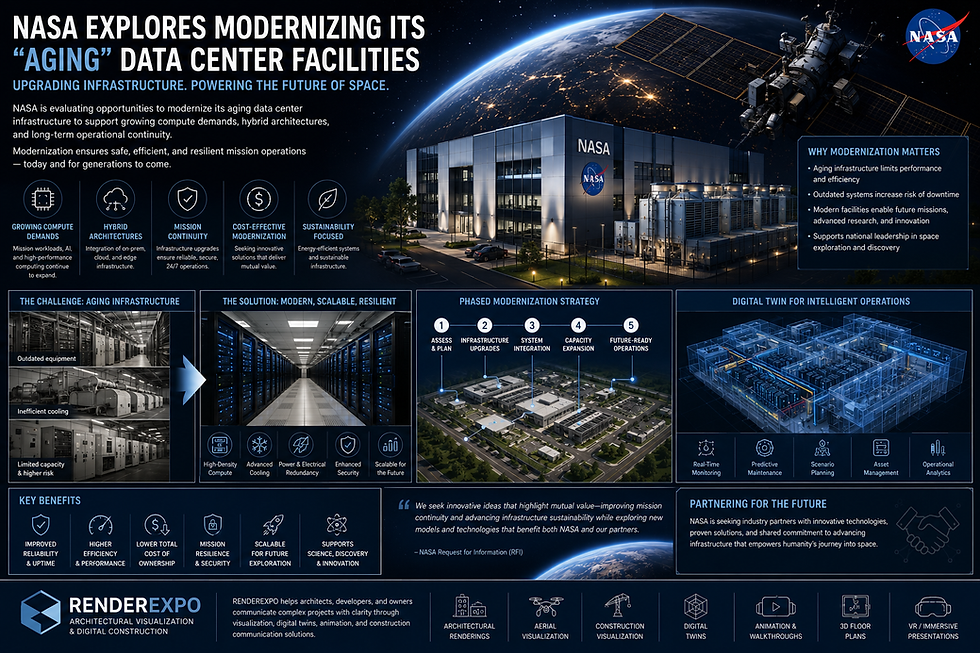
Why Data Center Modernization Is No Longer Optional
Many data centers were designed for earlier generations of computing. Their physical infrastructure may still function, but the demands placed on them have changed significantly. High-density racks, cloud-hybrid operations, AI workloads, mission-critical research, redundancy expectations, cybersecurity requirements, and energy-efficiency targets all place pressure on older facilities.
Aging data center facilities often face several overlapping issues:
Outdated cooling systems
Limited power capacity
Inefficient space planning
Aging electrical and mechanical infrastructure
Poor phasing clarity during renovation
Restricted site expansion options
Increased risk of downtime during upgrades
Difficulty communicating technical decisions to non-technical stakeholders
These issues become more serious when the facility supports essential operations. In mission-critical environments, modernization cannot be treated like a standard renovation. Construction activity must be planned around continuity, redundancy, security, access control, operational safety, and long-term performance.
A data center modernization strategy therefore needs more than engineering calculations and equipment schedules. It needs a visual and spatial communication framework that allows every stakeholder to understand what is changing, why it matters, and how the work will be executed.
Data Center Modernization and the Rise of Hybrid Infrastructure
One of the most important shifts in data center planning is the move toward hybrid infrastructure. Many organizations are no longer choosing between on-premises data centers and cloud environments. Instead, they are building integrated ecosystems where legacy facilities, cloud platforms, edge computing, high-performance computing, and secure internal systems work together.
That creates a new planning challenge. Physical infrastructure must be evaluated in relation to digital infrastructure. A modernization project may involve new server halls, upgraded cooling plants, electrical service improvements, fiber routes, backup systems, secure control rooms, administrative support spaces, exterior equipment yards, and phased construction zones.
Without clear visualization, the project can become difficult to explain. Leadership teams may understand the budget but not the spatial consequences. Facility managers may understand operations but not how phasing affects construction access. Public agencies may understand the need for modernization but require clearer evidence for approvals, funding, or stakeholder review.
For this reason, data center visualization is not simply a marketing tool. It is a decision-making tool.

The Role of Architectural Visualization in Data Center Upgrades
Architectural visualization helps translate technical infrastructure into clear, readable, and persuasive visual information. For data center modernization projects, this can include exterior renderings, interior technical views, aerial site visuals, phasing diagrams, equipment-yard studies, access diagrams, and security-zone illustrations.
Aging data centers often involve complex existing conditions. Stakeholders may need to understand how a new generator yard relates to an existing building, how cooling equipment affects the exterior appearance, how expansion phases will affect parking and circulation, or how construction work can be completed without interrupting operations.
Professional data center renderings can clarify:
Existing facility constraints
Proposed exterior upgrades
Mechanical and electrical equipment locations
Screening strategies for equipment yards
Site access and service circulation
Security fencing and controlled zones
Expansion capacity
Public-facing architectural improvements
Relationship between buildings, infrastructure, and surrounding context
For developers and project owners, these visuals can support internal approvals, investor presentations, municipal review, community communication, and project marketing. For architects and engineers, they can help test whether infrastructure decisions are spatially and visually coordinated.
Construction Visualization for Phasing and Operational Continuity
One of the most sensitive aspects of data center modernization is phasing. Unlike new construction, modernization often happens around existing operations. Certain rooms, systems, or infrastructure pathways may need to remain active while upgrades are completed.
Construction visualization can make this process easier to plan and communicate. Instead of relying only on schedules, diagrams, or written narratives, teams can use 3D construction sequencing to show how work will unfold over time.
This can include:
Temporary construction access
Equipment replacement sequences
Crane and delivery routes
Generator and transformer installation phases
Cooling plant upgrades
Utility shutdown planning
Temporary redundancy measures
Safety and logistics zones
Final operational handover conditions
For mission-critical facilities, these visual tools can reduce confusion between project stakeholders. They help owners, contractors, consultants, and facility teams align around the same construction logic.
This is especially valuable when decision-makers are not deeply involved in daily technical coordination. A clear phasing animation or 3D sequence can explain a complex construction strategy faster than a long technical report.
Digital Twins for Data Center Modernization
Digital twins are becoming increasingly important in data center planning, operations, and modernization. A digital twin is not just a 3D model. It can become a structured digital representation of a facility that connects spatial information with operational, technical, and performance data.
For existing data centers, a digital twin can support modernization by helping teams understand current conditions, asset relationships, infrastructure dependencies, and future upgrade scenarios.
A digital twin for a data center may support:
Existing-condition documentation
Equipment mapping
Space planning and capacity studies
Cooling and airflow coordination
Infrastructure replacement planning
Facility management
Security and access planning
Preventive maintenance communication
Future expansion scenarios
The value of a digital twin depends on how it is built and how it is used. For modernization, the goal is not to create a visually attractive model only. The goal is to create a useful digital environment that supports better decisions across design, construction, and operations.
For owners managing aging facilities, this can be especially important. Older buildings often contain undocumented changes, legacy systems, and infrastructure conflicts. A carefully developed digital twin can help bring clarity to those conditions before major investment decisions are made.
Visualization Helps Bridge the Gap Between Budget and Scope
Budget pressure is a major factor in data center modernization. Public agencies, private owners, universities, research institutions, enterprise companies, and developers must often decide which upgrades are essential, which can be phased, and which provide the strongest operational value.
NASA’s FY 2027 budget request, for example, listed a total request of $18.8 billion, while also emphasizing the importance of resilient infrastructure and close coordination across civil, commercial, and national security space sectors. The broader lesson for infrastructure owners is clear: when budgets are constrained, communication quality becomes more important, not less.
Visualization helps connect funding decisions to visible outcomes. Instead of describing modernization only through technical language, project teams can show what each phase accomplishes. This can help decision-makers compare options, understand risk, prioritize critical upgrades, and communicate investment value.
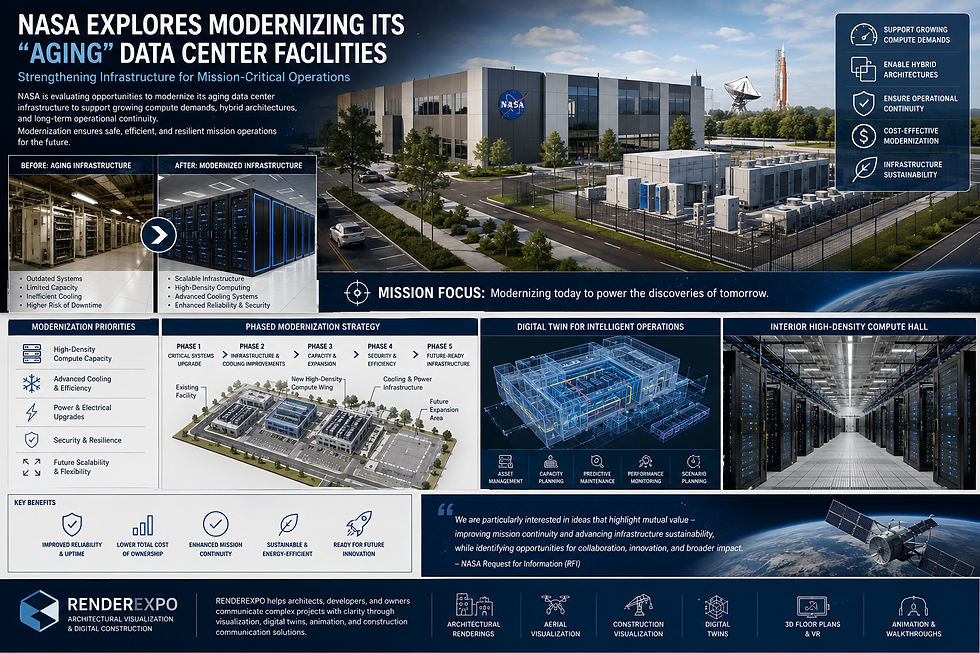
For example, a phased visual package may show:
Phase 1: critical electrical upgrades
Phase 2: cooling and redundancy improvements
Phase 3: exterior equipment-yard expansion
Phase 4: building envelope or security upgrades
Phase 5: future growth capacity
This type of visual structure helps leadership understand the modernization roadmap. It also helps technical teams communicate why certain upgrades must happen before others.
High-Performance Computing Requires Better Facility Communication
High-performance computing and advanced research workloads are placing new demands on facility infrastructure. A 2024 oversight report on high-end computing found that a lack of integrated strategy and executive-level coordination can limit an organization’s ability to manage specialized computing resources effectively.
For data center owners, this reinforces an important point: compute modernization is not only about buying newer hardware. It also requires facility strategy, infrastructure planning, leadership alignment, and clear communication between technical and non-technical teams.
When high-performance computing environments are involved, the physical facility becomes part of the computing strategy. Power density, cooling capacity, equipment layout, rack planning, redundancy, physical security, structural capacity, and operational access all shape what the computing environment can actually support.
Visualization can help explain those relationships. A project team can show how a new high-density computing area affects mechanical infrastructure, how cooling upgrades support future loads, or how phased infrastructure improvements reduce operational risk.
Data Center Renderings for Approvals, Investors, and Stakeholders
Data center projects often require communication with multiple audiences. Some stakeholders care about uptime and resilience. Others care about cost, schedule, entitlement, sustainability, site impact, energy use, or long-term development potential.
Renderings and visual communication packages can be tailored to each audience.
For internal leadership, visuals can explain investment priorities and modernization scenarios.
For investors, they can show future capacity, site strategy, and the credibility of the proposed upgrade.
For municipalities and review boards, they can clarify exterior appearance, screening, site circulation, stormwater areas, utility yards, and surrounding context.
For contractors, they can support sequencing, logistics, and coordination.
For marketing and leasing, they can position the facility as modern, secure, scalable, and professionally planned.
The strongest data center visualization work is not decorative. It is strategic. It gives each stakeholder the information needed to make decisions with confidence.
What Should Be Included in a Data Center Modernization Visual Package?
A strong visual package for data center modernization should be built around the project’s actual decision points. The goal is not to produce more images than necessary. The goal is to produce the right visuals for the right audience.
A complete package may include:
Existing Conditions Visuals
These help explain the current facility, site limitations, equipment locations, access constraints, and areas requiring upgrades.
Exterior Architectural Renderings
These show building improvements, equipment screening, site upgrades, security fencing, landscape strategies, and public-facing views.
Aerial Site Renderings
Aerial views are especially useful for data centers because they show the relationship between the building, utility infrastructure, access roads, equipment yards, parking, service circulation, and expansion zones.
Interior Technical Renderings
Interior views can show server rooms, control rooms, operations spaces, MEP corridors, cooling systems, and support areas.
Phasing Diagrams and Animations
These explain how modernization will be completed over time while maintaining operational continuity.
3D Floor Plans
3D floor plans can help non-technical stakeholders understand space use, equipment layout, circulation, and operational zones.
Digital Twin or Interactive Model
For larger or long-term facilities, an interactive digital model can support planning, coordination, operations, and future upgrades.
How RENDEREXPO Supports Data Center Modernization
RENDEREXPO supports data center modernization through architectural visualization, digital construction, construction visualization, 3D modeling, animation, aerial renderings, 3D floor plans, VR presentations, and digital twin strategies.
The value is not only in producing polished visuals. The value is in helping project teams communicate complex infrastructure clearly. RENDEREXPO understands that data centers are technical buildings with operational consequences. Every image, diagram, sequence, or model should support a real project decision.
For architects, RENDEREXPO can help communicate design intent and technical coordination.
For developers and owners, RENDEREXPO can support investor presentations, approval packages, leasing materials, and internal decision-making.
For contractors and construction managers, RENDEREXPO can help explain logistics, phasing, equipment installation, and construction sequencing.
For mission-critical and infrastructure-related projects, RENDEREXPO can help turn complex facility strategies into clear visual narratives that stakeholders can understand.
FAQ Section: Data Center Modernization
What is data center modernization?
Data center modernization is the process of upgrading an existing data center facility, infrastructure, or operating environment to support current and future computing needs. It may include improvements to power, cooling, security, equipment layout, hybrid infrastructure, digital systems, and building performance.
Why are aging data centers difficult to upgrade?
Aging data centers are difficult to upgrade because they often contain legacy systems, limited power capacity, outdated cooling infrastructure, documentation gaps, and operational constraints. Many must remain active during renovation, which makes phasing and construction coordination especially important.
How does visualization help data center modernization?
Visualization helps data center modernization by making complex infrastructure decisions easier to understand. Renderings, phasing diagrams, animations, aerial views, and digital models can explain design intent, construction sequencing, equipment locations, site impacts, and operational strategies.
What visuals are most useful for a data center project?
The most useful visuals often include exterior renderings, aerial site views, equipment-yard studies, 3D floor plans, construction phasing diagrams, logistics animations, interior technical renderings, and digital twin models. The right package depends on the project’s audience and approval needs.
What is a digital twin for a data center?
A digital twin for a data center is a digital representation of the facility that can connect spatial, operational, and technical information. It may be used for planning, asset documentation, maintenance, future upgrades, capacity studies, and stakeholder communication.
Can renderings help with data center approvals?
Yes. Data center renderings can help with municipal approvals, public presentations, internal reviews, entitlement packages, and investor communication. They can show building appearance, site planning, screening, access, security zones, and infrastructure relationships clearly.
Why is construction visualization important for mission-critical facilities?
Construction visualization is important for mission-critical facilities because upgrades often need to happen without interrupting operations. Visual sequencing can show how construction will be phased, where temporary access will occur, and how critical systems will remain protected during the work.
Conclusion
Data center modernization is no longer a purely technical discussion. It is a strategic planning, communication, infrastructure, and delivery challenge. Aging facilities must support higher compute demands, hybrid operations, stronger resilience, improved sustainability, and more complex stakeholder expectations.
The organizations that manage these upgrades successfully are the ones that make technical information visible, understandable, and actionable. Renderings, animations, aerial views, 3D floor plans, construction visualization, and digital twins can help project teams explain what needs to happen, why it matters, and how the work can be delivered with less confusion.
For architects, developers, contractors, public agencies, and data center owners planning a data center modernization project, RENDEREXPO can support the process with professional architectural visualization, digital construction visuals, phasing animations, digital twin strategies, and project communication materials tailored to serious infrastructure decisions.


Comments